
Free Lesson Preview
Enjoyed this preview?
This lesson is part of a complete GCP track — 2 courses, quizzes, a final exam, and a free verifiable credential. The optional $29 PDF certificate is recognized by 18+ trial sponsors.
Start learning for freeGood Clinical Practice (GCP)
Full course · ICH E6(R3) Principles
Free Lesson Preview
Enjoyed this preview?
This lesson is part of a complete GCP track — 2 courses, quizzes, a final exam, and a free verifiable credential. The optional $29 PDF certificate is recognized by 18+ trial sponsors.
Start learning for freeLearn how ICH E6(R3) redefines trial quality as fitness for purpose, requiring sponsors to prospectively identify critical to quality factors and build quality into trial design from the outset.
For decades, quality in clinical trials was treated as an afterthought. Sponsors designed protocols, trained sites, and then deployed armies of monitors to catch errors after they occurred. The implicit philosophy was simple: conduct the trial, then verify that it was done correctly. This model, while familiar, has a fundamental limitation. It addresses quality by detection rather than quality by design.
ICH E6(R3) represents a philosophical transformation in how we think about trial quality. The revised guideline asks a different question: instead of asking "Did we do it right?", it asks "Did we design it so that doing it right is the natural outcome?"
This shift matters enormously. A trial designed without quality considerations will generate errors that no amount of monitoring can fully correct. Data entered incorrectly, protocol deviations that were predictable but not prevented, participant burdens that lead to dropout, all of these problems have roots in design decisions. E6(R3) recognizes that the most effective way to ensure quality is to build it in from the beginning.
What you will learn5 objectives
By the end of this lesson, you will be able to:
Principle 6 of ICH E6(R3) articulates a vision of quality that may feel unfamiliar to those trained under earlier paradigms. The language is deceptively simple, but its implications are profound.
Three phrases in this principle deserve careful attention.
"Built into the design" signals the fundamental shift from reactive to proactive quality management. Quality is not something you verify after the fact; it is something you engineer from the start. The design phase is when quality decisions are made, whether consciously or by default. E6(R3) insists they be made consciously.
"Design and conduct" acknowledges that quality requires attention at both phases. A brilliantly designed trial can still fail through poor execution. A well-executed trial can still fail if the design was flawed. Quality must be woven through both.
specifies the two dimensions in which quality must be engineered. Scientific design encompasses the choice of endpoints, study population, comparators, and statistical methodology — decisions that determine whether the trial can answer its research question. Operational design encompasses monitoring strategies, data collection processes, site management, and training — decisions that determine whether the trial can execute its scientific design reliably. E6(R3) insists that quality considerations must inform both dimensions, not merely the operational side.
The first sub-principle defines what quality actually means in the context of clinical trials.
This definition represents a significant departure from traditional thinking. Under the older model, quality often meant compliance. A high-quality trial was one where all the boxes were checked, all the procedures followed, all the monitoring visits completed on schedule. This approach, while not without value, conflated means with ends.
Fitness for purpose asks a different question: Does the trial accomplish what it needs to accomplish? A protocol might be followed perfectly while still failing to protect participants or generate reliable data. Conversely, a trial might deviate from certain procedural requirements while still achieving its fundamental objectives. Fitness for purpose focuses attention on outcomes rather than mere adherence.
Consider the difference in practice. Under a compliance model, a monitor might spend hours verifying that source documents are signed in blue ink as the protocol specified. Under a fitness-for-purpose model, the relevant question is whether the signature authentically documents who made the entry and when. The ink color is a means to an end; the authentication is the end itself.
The fitness-for-purpose definition has concrete implications for how trials are designed and conducted.
Proportionate effort: Not all activities in a trial are equally important. Some procedures are critical to participant safety; others are administrative conveniences. A fitness-for-purpose approach directs resources toward what matters most. The sponsor should invest heavily in activities that protect participants and ensure data reliability, while potentially simplifying activities that serve neither purpose.
Contextual judgment: What constitutes "fitness" depends on the specific trial. A first-in-human study of a novel oncology compound has different quality requirements than a Phase IV study of a well-characterized diabetes medication. The fitness-for-purpose standard allows quality approaches to be tailored to the context.
: Quality is measured by whether the trial achieves its objectives, not by whether every procedural detail was followed exactly. This does not mean procedures do not matter. It means that procedures are valuable to the extent they contribute to the ultimate goals.
The second sub-principle introduces two of the most important concepts in E6(R3): critical to quality factors and quality by design.
Critical to quality (CtQ) factors are those elements of a clinical trial that, if they fail, would meaningfully compromise participant protection or the reliability of trial results. They are the essential activities, data, and processes without which the trial cannot achieve its objectives.
Identifying CtQ factors requires asking: What must go right for this trial to succeed? The answer will vary by trial, but certain categories of CtQ factors appear frequently.
Common Categories of Critical to Quality Factors
The validity of informed consent is critical to nearly every trial. If participants do not truly understand what they are agreeing to, both their protection and the ethical foundation of the research are compromised. CtQ factors in this category might include comprehension of key risks, voluntariness of decision-making, and documentation of the consent process.
The primary endpoint is what the trial exists to measure. Data quality for primary endpoint assessments is almost always critical. This includes the accuracy of measurements, consistency of methods across sites, blinding integrity (where applicable), and timeliness of assessments within protocol-specified windows.
Enrolling participants who do not meet eligibility criteria can compromise both their safety and the interpretability of results. For trials with narrow therapeutic windows or vulnerable populations, eligibility verification is a CtQ factor requiring robust verification procedures.
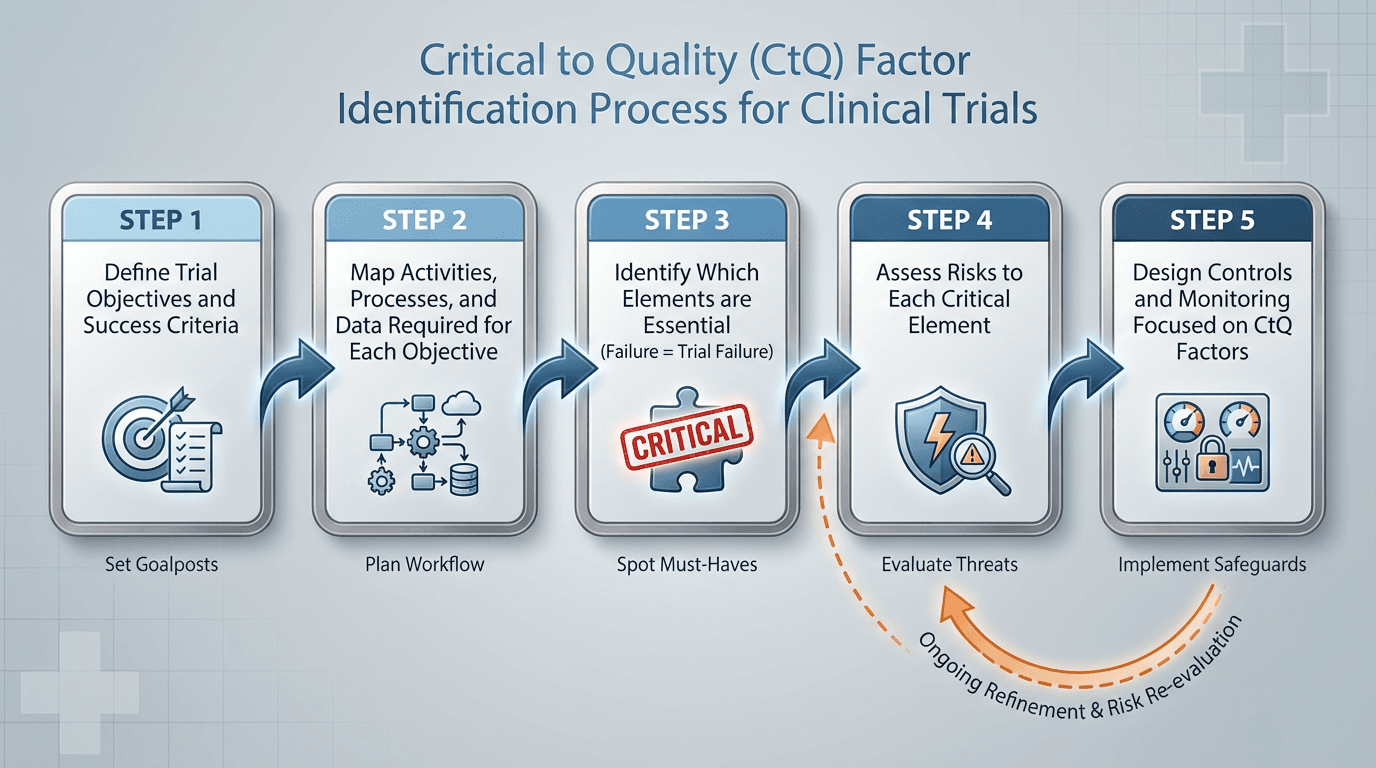
Identifying critical to quality factors is not a casual exercise. It requires systematic analysis that begins during trial design and continues throughout the trial lifecycle.
The process typically involves several steps. First, the sponsor examines the trial objectives and identifies what must be achieved for the trial to succeed. Second, the sponsor identifies the processes, data, and activities that are essential to those objectives. Third, the sponsor evaluates risks to those critical elements and determines which require enhanced attention.
Quality by design (QbD) is the operational philosophy that Sub-principle 6.2 mandates. Rather than treating quality as something to be inspected into the trial after the fact, QbD builds quality into the trial from its inception.
The contrast with traditional approaches is stark. In a traditional model, a sponsor designs a trial, initiates it, and then discovers problems through monitoring. The problems are addressed as they arise, often through corrective actions that are reactive and sometimes too late. In a QbD model, the sponsor anticipates potential problems during design, implements prospective controls to prevent them, and monitors to verify that controls are working rather than to discover errors.
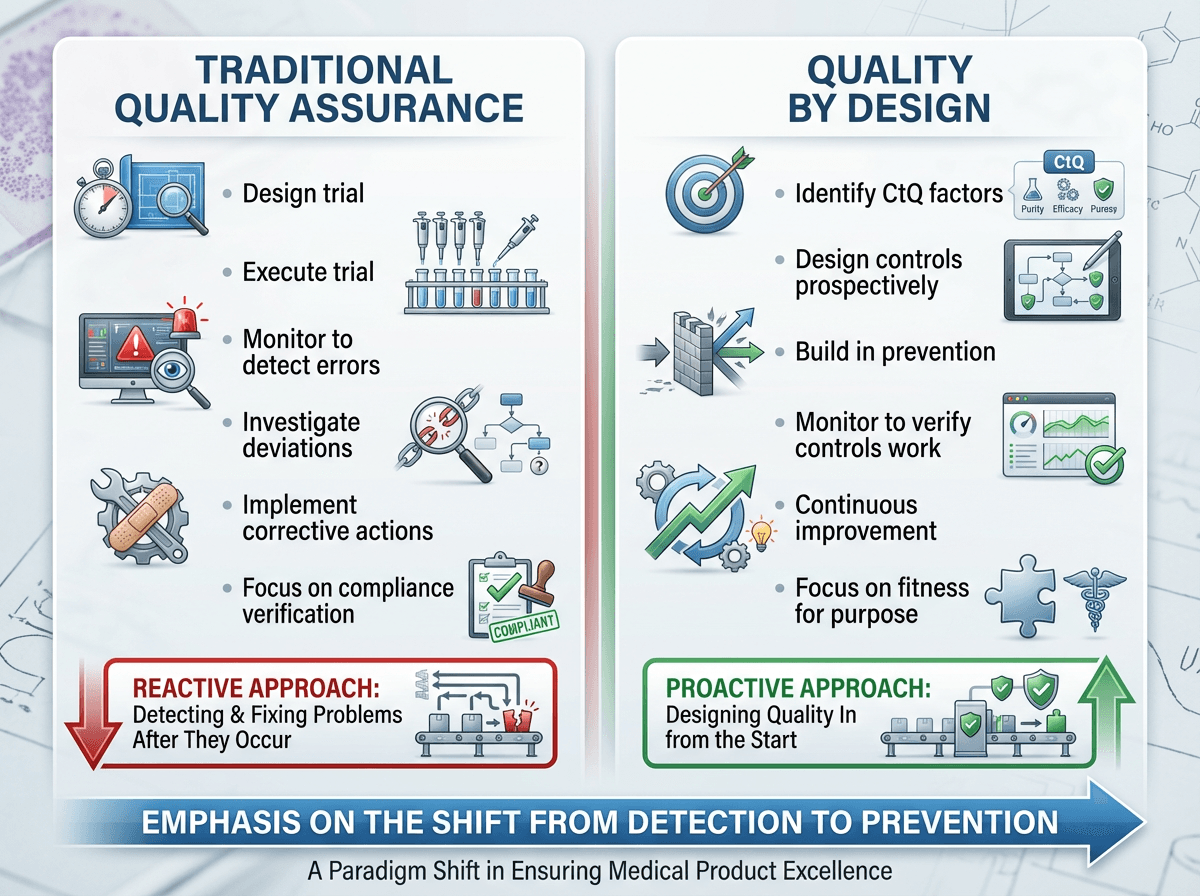
Quality by design is not merely an aspiration; it involves specific activities that sponsors should undertake.
Prospective risk identification: Before the trial begins, the sponsor systematically identifies what could go wrong. This is not pessimism; it is prudent planning. What errors are likely at sites? What data are most vulnerable to quality problems? What participant populations face elevated risks?
Designed-in controls: For each identified risk, especially those affecting CtQ factors, the sponsor designs controls. These might include protocol simplification, enhanced training, centralized assessments, eligibility verification procedures, or electronic data capture features that prevent entry errors.
: Monitoring strategies are designed based on the risk profile and CtQ factors, not on a one-size-fits-all template. High-risk elements receive intensive oversight; lower-risk elements receive proportionate attention.
The third sub-principle addresses the relationship between quality management and regulatory compliance.
Sub-principle 6.3 establishes a comprehensive approach to serious noncompliance: avoid it, detect it, address it, and prevent its recurrence. The traditional model often focused primarily on detection — determining whether a site was compliant or not after the fact. E6(R3) goes further, asking sponsors to also think proactively. If a site is likely to become noncompliant, what can be done to avoid that outcome in the first place?
Serious noncompliance is not merely procedural deviation. It refers to failures that meaningfully compromise participant protection, data integrity, or the validity of trial conclusions. A typographical error on a case report form is a minor discrepancy. Systematic fabrication of data is serious noncompliance. Enrolling participants who do not meet eligibility criteria in ways that endanger their health is serious noncompliance.
The quality management system should anticipate the conditions that lead to serious noncompliance. A site with insufficient staff may struggle to meet enrollment timelines and cut corners. A complex protocol may be misunderstood, leading to systematic protocol deviations. An investigational product with stringent storage requirements may be mishandled at sites without proper facilities.
TableFactors That Can Lead to Serious Noncompliance
| Insufficient site resources | Delegation of tasks to unqualified staff, incomplete documentation | Site capability assessment before selection, realistic enrollment targets |
| Protocol complexity | Misunderstanding of requirements, systematic deviations | Protocol optimization, enhanced training, visual aids, decision support tools |
| Inadequate training | Incorrect procedures, inconsistent data collection | Role-specific training, competency verification, refresher training when needed |
| Poor communication channels | Delayed reporting, unanswered queries, emerging issues not escalated | Clear escalation pathways, regular contact, accessible sponsor personnel |
| Unrealistic timelines | Pressure to enroll ineligible participants, rushed assessments | Feasibility assessment, protocol amendments when necessary, timeline adjustments |
Prevention begins at trial design. A protocol that is clear, logical, and feasible is less likely to generate noncompliance than one that is ambiguous, complex, or impractical. The sponsor should ask whether the protocol can reasonably be followed at the sites selected and with the resources available.
Site selection and qualification represent a critical prevention opportunity. Sites with appropriate facilities, qualified personnel, adequate patient populations, and institutional support are more likely to maintain compliance. Selecting sites based solely on enrollment promises, without assessing capability, is a recipe for future problems.
Training must be sufficient and ongoing. Initial training before the trial begins is necessary but not always sufficient. Refresher training when problems emerge, updates when protocols are amended, and targeted training when monitoring identifies deficiencies all contribute to sustained compliance.
Monitoring and oversight should be designed to identify emerging compliance risks, not just completed violations. If a site is trending toward a problem, early intervention can prevent what would otherwise become serious noncompliance. This requires centralized review of data trends, not merely site-by-site verification of completed activities.
E6(R3) does not exist in isolation. Its quality requirements connect to the broader ICH quality framework, particularly ICH E8(R1), which addresses general considerations for clinical studies.
ICH E8(R1), finalized in 2021, introduced quality by design concepts at the study design level. It emphasized that quality begins with a clear definition of what the study needs to achieve and that study design should reflect that definition. E6(R3) extends these concepts into the operational realm of trial conduct.
The E8(R1) framework identifies several quality elements that align with E6(R3) Principle 6:
Defining quality: E8(R1) defines quality in clinical studies in terms of fitness for intended use of the study results. This aligns directly with E6(R3)'s fitness for purpose definition.
: E8(R1) calls for identifying the processes and data critical to study objectives. This parallels E6(R3)'s requirement for CtQ factor identification.
The concepts in Principle 6 have concrete implications for how sponsors, investigators, and site personnel approach their work.
For sponsors, Principle 6 requires a fundamental shift in how trials are planned. Quality is no longer a separate function that inspects completed work; it is integrated into every design decision. Sponsors must prospectively identify CtQ factors, design controls to protect them, and allocate resources according to importance rather than tradition.
For investigators and site personnel, the fitness-for-purpose standard offers both freedom and responsibility. Freedom, because it allows focus on what genuinely matters rather than ritual compliance with procedures of dubious value. Responsibility, because the burden shifts toward ensuring that critical activities are done well, not merely done.
For monitors and oversight personnel, Principle 6 means verification strategies should focus on CtQ factors. The days of verifying every source document on every visit for every participant may be passing. In their place, targeted verification of critical data points, combined with centralized review of patterns and trends, offers a more effective use of oversight resources.
Case study · Clinical Research · intermediate · 10-15 minutes
"Identifying Critical to Quality Factors for CARDINAL-HF"
Marcus Chen, a clinical research coordinator at Lakewood Community Hospital, was reviewing the monitoring report from Sarah Lindqvist, the CRA from GlobalClinical CRO assigned to the CARDINAL-HF trial. The Phase III cardiovascular study was testing NVX-4021 in patients with heart failure with preserved ejection fraction.
Sarah had mentioned during her last visit that the sponsor was implementing a quality by design approach and had identified specific critical to quality factors for the trial. Marcus was curious about how this would affect his daily work.
"When we identified the CtQ factors," Sarah explained, "we started with what the trial absolutely needs to achieve. For CARDINAL-HF, that means accurately measuring whether NVX-4021 reduces the composite endpoint of cardiovascular death and heart failure hospitalization. If we cannot trust that measurement, the trial fails its purpose."
She walked Marcus through the CtQ factors the sponsor had identified:
"Notice what is not on this list," Sarah continued. "We have dozens of procedures and data points in this trial. But the ones I just mentioned are where we cannot afford to fail. That does not mean the other procedures do not matter. It means we focus our attention and resources where they matter most."
Marcus realized this explained why Sarah spent so much time during visits reviewing consent documentation and eligibility source documents, while other data points received less intensive verification. The monitoring was designed around the CtQ factors.
Question 1 of 4. Not yet answered.
Progress saves itself — finish reading and this lesson completes
Correct dosing, timing, and route of administration are typically critical. Errors in IP administration can harm participants and confound efficacy and safety assessments. Storage conditions and accountability are also important for ensuring product integrity.
The ability to detect, assess, and report adverse events is fundamental to participant protection. Late detection or underreporting of safety signals can lead to preventable harm and regulatory consequences. This is particularly critical for serious adverse events and suspected unexpected serious adverse reactions.
Feedback mechanisms: QbD includes systems to detect when controls are not working as intended. Centralized monitoring, key risk indicators, and quality tolerance limits allow sponsors to identify emerging problems before they become widespread.
Proportionate approaches: E8(R1) emphasizes that quality approaches should be proportionate to the risks and importance of various study elements. E6(R3) extends this into proportionate risk-based quality management.
For practitioners, the alignment between E8(R1) and E6(R3) means that quality thinking should be consistent from study design through trial conduct. The same factors identified as critical in the study design phase under E8(R1) should be the factors monitored most carefully during conduct under E6(R3).
Reflection questions: