
Regulatory Coordinator6 of 7
Free Lesson Preview
Enjoyed this preview?
View the Regulatory Coordinator track for current pricing and enrollment options.
View enrollment optionsRegulatory Coordinator
Full course · Inspection Readiness and Regulatory Quality Management
Free Lesson Preview
Enjoyed this preview?
View the Regulatory Coordinator track for current pricing and enrollment options.
View enrollment optionsDissects the fundamental failure mode of reactive inspection preparation and introduces the distinction between surface-level and substantive readiness.
The regulatory coordinator opens an email on a Tuesday morning and reads the sentence that every research site dreads: the FDA has scheduled a Bioresearch Monitoring (BIMO) inspection, and the agency will arrive in 14 days. Within an hour, the site erupts. The principal investigator cancels clinic appointments to review regulatory binders. Coordinators pull double shifts to reconcile source documents with case report forms. The regulatory coordinator postpones enrollment activities and spends the next two weeks doing nothing but assembling, reviewing, and organizing files that should have been maintained all along.
I have seen this scene play out dozens of times across academic medical centers, community practices, and dedicated research sites. And I want to be direct with you: if that notification fundamentally changes how your site operates, it means your site was not ready. Not in the way that matters.
This lesson examines why that scramble -- however well-intentioned, however exhausting -- does not work. Not because the people involved lack competence or dedication, but because the approach itself has structural weaknesses that no amount of effort in a compressed timeline can overcome.
What you will learn3 objectives
By the end of this lesson, you will be able to:
When a site learns an inspection is imminent -- whether from the FDA, a sponsor, or a regulatory authority -- the response follows a predictable pattern. I call it the preparation cascade, and if you have worked in clinical research for more than a year, you will recognize every stage of it.
The first 48 hours are triage. Someone -- usually the regulatory coordinator -- performs a rapid inventory of essential records. Regulatory binders get pulled from shelves or accessed in electronic trial master files. The question is not "Are these documents correct?" but "Are these documents present?" There is a critical difference between those two questions, and that difference is where reactive preparation begins to fail.
The next several days involve what I sometimes describe, only half-jokingly, as cosmetic compliance. Pages get re-filed. Signature dates that were missed get flagged for retroactive collection -- which itself creates a documentation integrity problem. Training logs are updated to reflect training that may have occurred months ago but was never recorded contemporaneously. Delegation logs are reviewed and revised to match the current state of affairs, though the revisions themselves reveal that the logs were not maintained in real time.
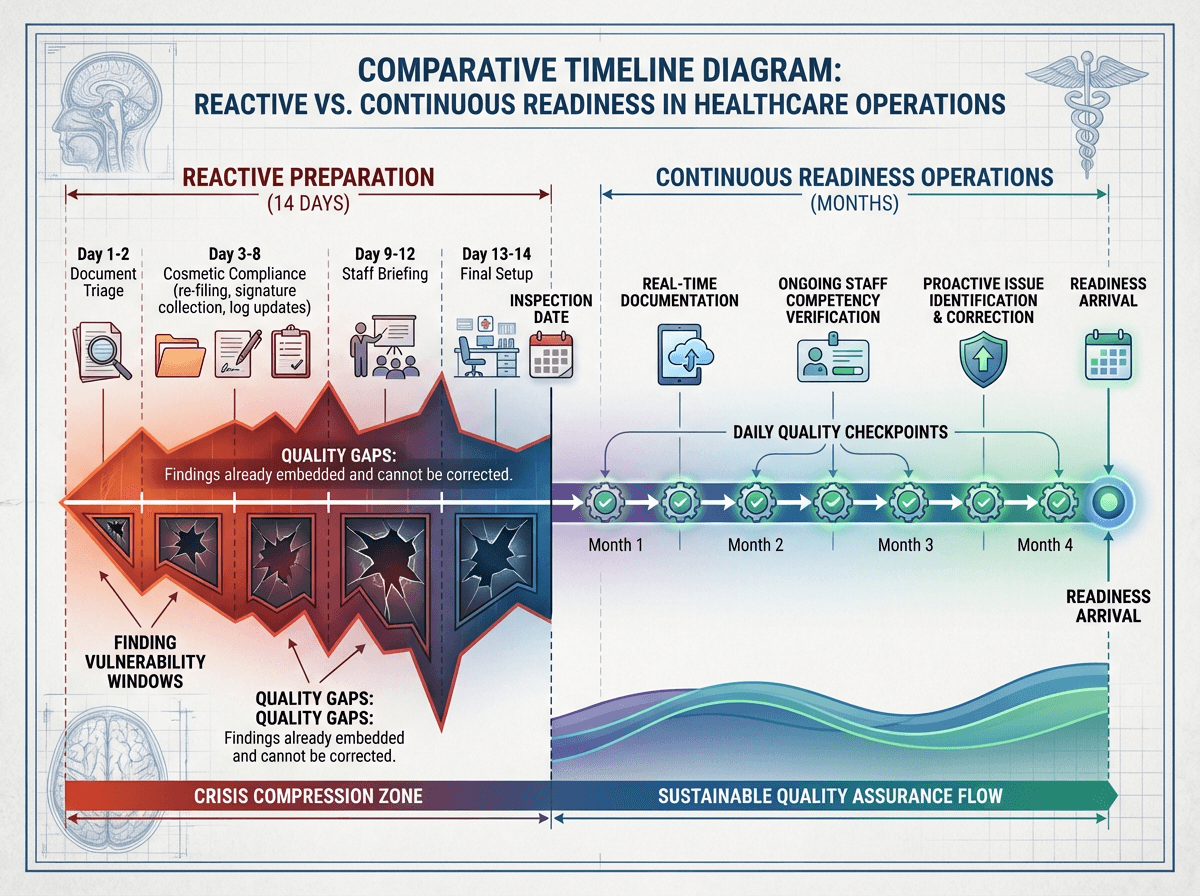
Here is the uncomfortable truth that experienced inspectors understand and that reactive sites discover too late: the most consequential inspection findings are not about missing documents. They are about missing systems. And systems cannot be built in two weeks.
FDA BIMO inspectors are trained to look beyond the binder. They review documents, yes -- but they also interview staff, observe processes, compare records against source data, and assess whether what the site describes as its practice actually matches what the records reflect. The findings that result from this scrutiny fall into categories that reactive preparation simply cannot reach.
Staff knowledge deficits. An inspector asks a coordinator to explain the adverse event reporting timeline for the study. The coordinator hesitates, refers to a laminated card taped to the wall, and provides an answer that is technically correct but clearly memorized rather than understood. Now the inspector asks a follow-up: "What happens if the event meets the criteria for both a serious adverse event and a protocol deviation? Which do you report first, and to whom?" That question requires not just knowledge of the reporting timeline but understanding of the intersection between safety reporting and protocol compliance -- something that comes from training and experience, not from a two-day briefing.
TableInspection finding categories and reactive preparation's reach
| Missing documents | Absent forms, unfiled reports, incomplete binders | Partially -- documents can be located and filed, but gaps in filing dates remain visible |
| Staff knowledge deficits | Hesitant answers, scripted responses, inability to handle follow-up questions | No -- understanding cannot be built in days; memorized answers collapse under probing |
| Process inconsistencies | Different procedures across studies without SOP-based justification | No -- SOPs cannot be retroactively created and credibly implemented |
| Temporal documentation gaps | Training dates after task performance, late signatures, backdated entries | No -- historical timestamps are immutable; corrective notes highlight the original gap |
| Quality system absence | No evidence of self-inspection, deviation tracking, or trend analysis | No -- a quality system requires months of operation to produce meaningful records |
Beyond its ineffectiveness at preventing findings, reactive preparation carries real operational costs that sites rarely quantify. I want to walk through three of them, because understanding these costs is essential to making the organizational case for continuous readiness -- a case you will need to make to your principal investigators, your site management, and sometimes yourself.
Staff time diversion. When the regulatory coordinator spends two weeks preparing for an inspection, those two weeks are not free. Every hour spent re-filing documents is an hour not spent on active regulatory submissions. Every evening a coordinator stays late to reconcile source documents is capacity pulled from enrollment support. In a study portfolio with active enrollment, this diversion is not merely inconvenient -- it is financially consequential. Sponsors notice when enrollment slows. CRAs notice when queries accumulate. And the irony is acute: the very act of preparing for an inspection can create new problems that a future inspector will identify.
At a multi-study site managing 15 to 20 active protocols, a two-week inspection preparation period can reduce enrollment capacity — some site directors estimate by 30% to 50%. Screening visits are deferred. Randomization timelines slip. In competitive enrollment environments, those participants go to other sites -- and they do not come back. I have spoken with site directors who estimate the revenue impact of a single reactive preparation cycle at $40,000 to $75,000 in lost per-subject fees, depending on the therapeutic area.
The distinction I want to draw here goes to the heart of what ICH E6(R3) Principle 6 demands from everyone involved in clinical research. Principle 6 establishes that quality should be built into the design and conduct of a clinical trial -- not inspected into it after the fact. This is the quality-by-design principle, and it has a direct parallel to inspection readiness.
Surface readiness is what you can achieve in two weeks. Documents are filed. Binders are indexed. Staff have been briefed. The conference room is clean. If an inspector were to walk in and only open binders, the site might survive. But inspectors do not only open binders.
Substantive readiness is what you can only achieve through sustained operational discipline. It means that when the inspector asks a coordinator to walk through the informed consent process, the coordinator does not recite a script -- she describes what she actually does, because what she actually does matches the protocol and the site's SOPs. It means that when the inspector reviews the delegation log, every entry has a corresponding training record dated before or on the date of delegation. It means that when the inspector asks the regulatory coordinator how the site identifies and trends deviations, the coordinator can produce six months of deviation logs with root cause categories, corrective actions, and evidence that the corrective actions worked.
Surface readiness vs. substantive readiness: what the inspector actually evaluates
Binders are organized, tabbed, and indexed. Documents are present in the correct sections. Filing is up to date. This satisfies the most basic inspection expectation, but experienced inspectors treat organization as baseline -- not evidence of quality. A perfectly organized binder with temporal gaps, missing signatures, or inconsistent version histories tells a more revealing story than a messy binder with complete records.
Staff can describe their actual workflow without reference to written aids. They explain not just what they do, but why -- connecting their tasks to regulatory requirements and participant protections. They handle follow-up questions confidently because their knowledge comes from practice, not from a pre-inspection briefing session. Inspectors routinely test this by asking the same question to different staff members; consistent answers indicate trained teams, while divergent answers indicate coached individuals.
Documentation timestamps, signatures, and content demonstrate that records were created contemporaneously with the activities they describe. Training records predate delegated task performance. Amendment acknowledgments are documented before post-amendment activities begin. This temporal integrity is impossible to fabricate retroactively and is one of the first things experienced inspectors assess.
ICH E6(R3) Principle 6 states that quality management should be applied throughout the lifecycle of a clinical trial, with a focus on activities essential to participant protection and data reliability (Principle 6.1). It further specifies that the quality management approach should be proportionate to the risks inherent in the trial and the importance of the information collected (Principle 6.2). And it requires that the quality management system should identify risks to trial quality, evaluate those risks, and implement measures to control them (Principle 6.3).
Read those three sub-principles carefully, and you will notice something: none of them describe a two-week preparation period before an inspection. They describe a continuous system. Quality management "throughout the lifecycle." Risk identification and evaluation as ongoing activities. Control measures that are implemented -- present tense, sustained -- not assembled in a crisis.
This is why reactive preparation fails at a structural level. It attempts to demonstrate a quality management system that does not exist by producing artifacts that suggest it does. And experienced inspectors -- the ones who have reviewed hundreds of sites -- can distinguish between a system that generates records as a byproduct of daily operations and a collection of records assembled to simulate a system.
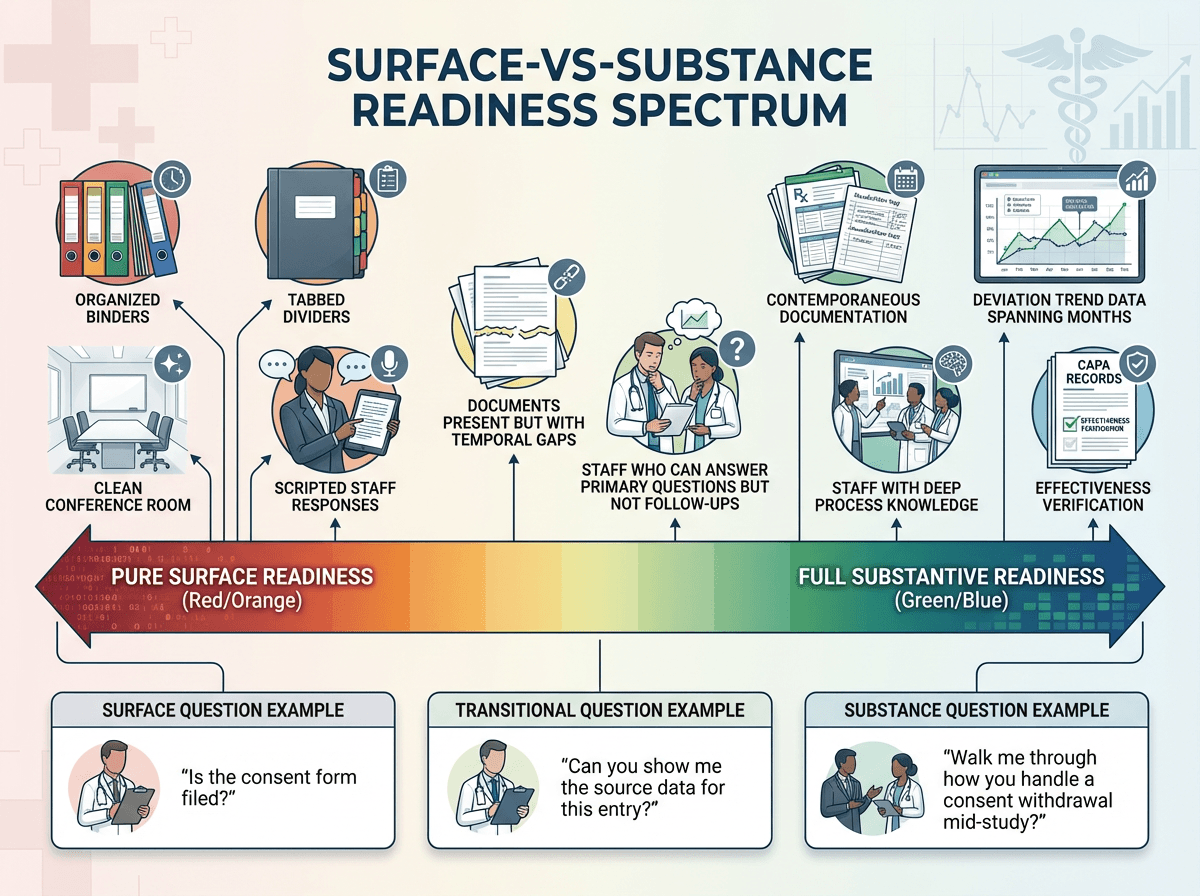
The distinction between surface and substance is not academic. It plays out every time an inspector arrives at a site that has spent two weeks preparing and discovers, within the first morning, that the preparation was cosmetic. The following case study illustrates this pattern -- and the moment when the gap between "looking ready" and "being ready" becomes visible.
Case study · Clinical Research · intermediate · 10-15 minutes
"Fourteen days and counting"
Scenario
Helen Marchetti, Senior Regulatory Coordinator at Riverside Medical Center in Columbus, Ohio, receives an FDA BIMO inspection notification on a Monday morning. The inspection will begin in exactly 14 days, covering Riverside's participation in the CARDIO-PROTECT Phase III cardiovascular outcomes trial. Dr. Raymond Okafor, the principal investigator on CARDIO-PROTECT, immediately clears his Wednesday clinic to begin reviewing regulatory binders.
Helen faces a choice about how to spend the next two weeks. She can pursue reactive preparation -- pulling binders, re-filing documents, updating logs, and briefing staff -- or she can honestly assess which of her preparation activities are cosmetic and which reflect genuine operational gaps.
During her initial triage, Helen identifies the following:
The challenge: Helen realizes she can organize the binders, brief Dr. Okafor, and prepare scripted responses in 14 days. But she cannot create nine months of deviation trend data. She cannot change the dates on delegation logs and training records. She cannot retroactively establish an SOP that would have governed the consent process across all studies.
Analysis
Helen's situation illustrates the central argument of this lesson: reactive preparation can organize what exists, but it cannot create what should have existed all along. The knowledge check below asks you to apply this distinction to specific preparation activities.
Question 1 of 4. Not yet answered.
This lesson has argued a position that, in my experience, many research professionals recognize intuitively but struggle to articulate to their organizations: the two-week scramble does not work. Not because the people involved are insufficiently dedicated, but because the approach is structurally incapable of addressing the findings that matter most.
The categories of findings that reactive preparation cannot fix -- staff knowledge deficits, process inconsistencies, temporal documentation gaps, and the absence of quality systems -- are precisely the categories that experienced inspectors prioritize. An organized binder with a temporal gap in its delegation log is worse, from an inspection perspective, than a disorganized binder with complete contemporaneous records. Substance outweighs surface every time.
The operational costs of reactive preparation -- staff diversion, enrollment disruption, and the compounding of existing deficiencies through rushed corrections -- mean that the scramble is not merely ineffective but actively harmful. It pulls resources from productive work to perform cosmetic improvements that do not reduce inspection risk.
Progress saves itself — finish reading and this lesson completes
The final days before the inspection are devoted to staff briefing. The principal investigator, who may not have reviewed the protocol in detail since the last amendment, receives a refresher. Coordinators practice explaining their procedures. The regulatory coordinator compiles a list of anticipated questions and prepares scripted responses.
All of this activity creates the appearance of readiness. Files are organized. Staff can articulate their roles. The conference room is set up with labeled binders and a welcoming demeanor. But none of this is readiness. It is stagecraft.
Process inconsistencies across studies. The regulatory coordinator has assembled organized binders for each study. But when the inspector compares the informed consent process described in Study A's regulatory file with the process described in Study B's file, the procedures differ in ways that are not explained by protocol differences. One study documents consent conversations in progress notes; another documents them on a separate consent worksheet. Neither is wrong, but the inconsistency suggests an absence of site-level standard operating procedures -- which is precisely what the inspector notes.
Temporal documentation gaps. This is, in my view, the most damaging category of reactive-preparation failure. An inspector reviews a delegation log and notices that a new coordinator was added on March 15 but the corresponding training documentation is dated April 2 -- two weeks after the coordinator began performing delegated tasks. No amount of re-filing can change those dates. The gap is embedded in the historical record, and it tells a story about a site that does not train before delegating. That story is far more consequential than a missing document, because it reveals a process failure.
Compounding existing deficiencies. This is the cost that sites understand least. When you rush to fix problems under time pressure, you introduce new errors. A coordinator backdating a training record to cover a gap inadvertently creates a documentation integrity issue that is worse than the original training delay. A regulatory coordinator who hastily updates an IRB correspondence log may transpose approval dates, creating a discrepancy between the IRB's records and the site's records. Compressed timelines produce compressed quality, and compressed quality produces new findings.
Substantive readiness, in other words, is not about documents. It is about operations. And operations take time to build.
The site can produce deviation logs, CAPA records, self-inspection reports, and trend analyses covering months of operations. These records demonstrate not just that problems were found, but that they were systematically addressed and that corrective actions were verified for effectiveness. Per ICH E6(R3) Principle 6 (6.1-6.3), this is the evidence of quality-by-design: a system that detects, corrects, and prevents quality failures as part of routine operations.
The next lesson introduces the specific quality management framework from ICH E6(R3) Section 3.10 that operationalizes these principles into a site-level quality management system. But the philosophical shift must come first. Continuous readiness is not a more expensive version of reactive preparation. It is a fundamentally different approach to running a research site.
And the distinction between surface readiness and substantive readiness, grounded in ICH E6(R3) Principle 6, gives you the framework to evaluate your own site honestly. When you look at your regulatory operations today, are you seeing a system that generates quality as a byproduct of daily work? Or are you seeing a collection of files that will need to be organized when someone important comes to look?
The next lesson introduces the specific quality management framework from ICH E6(R3) Section 3.10 that transforms this philosophical distinction into an operational system. But the philosophical shift must come first. Continuous readiness is not a more expensive version of reactive preparation. It is a fundamentally different approach to running a research site.