
Regulatory Coordinator6 of 7
Free Lesson Preview
Enjoyed this preview?
View the Regulatory Coordinator track for current pricing and enrollment options.
View enrollment optionsRegulatory Coordinator
Full course · Inspection Readiness and Regulatory Quality Management
Free Lesson Preview
Enjoyed this preview?
View the Regulatory Coordinator track for current pricing and enrollment options.
View enrollment optionsCovers the FDA 483 response process in depth and provides substantive treatment of key procedural differences when the inspecting authority is EMA, MHRA, or Health Canada -- because an RC at a multi-national site or a site participating in global trials will encounter non-FDA inspections. Addresses regulatory, institutional, and sponsor notification obligations.
The closing meeting has concluded. The inspector has outlined the preliminary observations, thanked the site for its cooperation, and departed. The real-time documentation log from the previous lesson -- with its meticulous record of every document requested, every concern raised, every commitment made -- sits on the RC's desk. And now the work shifts from coordination to construction: building a response that addresses each finding with the depth, specificity, and systemic understanding that the regulatory authority expects.
I want to be direct about something. The response to inspection findings is, in my experience, the single deliverable that most clearly reveals whether a site truly understands quality management or merely performs compliance activities. A weak response -- one that acknowledges findings without demonstrating root cause understanding, or that promises corrections without describing how recurrence will be prevented -- signals to the regulatory authority that the site is reactive. A strong response demonstrates that the site grasps the systemic significance of each finding and has the organizational capacity to address it. The difference between these two responses is not cosmetic. It materially affects what happens next.
This lesson covers the response process for FDA 483 observations in detail, then provides substantive treatment of how that process differs when the inspecting authority is the European Medicines Agency (operating through national competent authorities), the United Kingdom's Medicines and Healthcare products Regulatory Agency, or Health Canada. If the site participates in global clinical trials -- and increasingly, even mid-sized investigator sites do -- the RC will encounter inspections from authorities beyond the FDA. The procedural differences are not trivial.
We then address the parallel notification obligations that accompany any inspection finding: what the regulatory authority requires, what the institution expects, and what the sponsor must be told. These three audiences want different things, on different timelines, at different levels of detail. The RC must satisfy all three.
What you will learn3 objectives
By the end of this lesson, you will be able to:
The FDA Form 483 -- formally titled "Inspectional Observations" -- is issued at the conclusion of an FDA inspection when the inspector has observed conditions that, in the inspector's judgment, may constitute violations of the Food, Drug, and Cosmetic Act and its implementing regulations. The 483 is presented to the site during the closing meeting, and the investigator receives a copy to review.
Here is what the 483 is not, and this distinction is consequential: a 483 observation is not a formal finding of violation. It is not a citation. It is not a penalty. It is a notification that the inspector observed conditions that may warrant further action. The word "may" is doing significant work in that sentence. The FDA's subsequent decision -- whether to issue a Warning Letter, take enforcement action, or close the matter -- depends substantially on the quality and timeliness of the site's response.
This is not a theoretical distinction. I have seen sites receive 483 observations for substantively identical issues and experience entirely different regulatory outcomes based on the quality of their responses. The site that demonstrates systemic understanding, implements meaningful corrective action, and responds within the expected timeframe communicates regulatory maturity. The site that provides a cursory acknowledgment and promises to "do better" communicates something else entirely.
The 483 response is addressed to the FDA district office that conducted the inspection, typically directed to the attention of the district director. It must address every observation on the 483 -- not selectively, not in summary, but each one individually. A response that addresses three of five observations and ignores two creates the inference that the site has no answer for the observations it omitted.
For each observation, the response must include four elements. The absence of any one weakens the entire response.
Acknowledgment of the observation. State what was observed, in the site's own words. This is not a verbatim restatement of the 483 language -- it is a demonstration that the site understands the substance of the finding. If the site disagrees with the observation's characterization, this is the place to provide clarifying context. But disagreement must be substantive and evidence-based, not defensive.
Explain why the condition existed. This is where Module 3 of this course proves its value. The reviewing official wants to see that the site has looked beyond the surface symptom to identify the systemic process, design, or resource failure that permitted the observation to occur. A response that says "the delegation log was incomplete because the coordinator forgot to update it" identifies a proximate cause. A response that says "the delegation log was incomplete because the site's process for updating delegation documentation following personnel changes lacked a systematic verification step" identifies a root cause.
Here is a reality that too many U.S.-focused training programs overlook: the FDA is not the only authority that inspects investigator sites, and it is not the only authority whose inspection procedures the RC must understand. A site participating in a multinational Phase III trial may be inspected by the European Medicines Agency (through its coordinated inspection program), the United Kingdom's MHRA, Health Canada, or -- depending on the trial's geographic reach -- regulatory authorities in Japan (PMDA), Australia (TGA), or Brazil (ANVISA).
The procedural differences between these authorities are not superficial variations on the same process. They involve fundamentally different notification practices, classification systems, response expectations, and escalation pathways. An RC who applies the FDA 483 response framework to an MHRA GCP inspection finding will miss critical procedural requirements. An RC who assumes all international inspections follow the FDA model will be caught unprepared when the inspection notification arrives -- or, in some cases, does not arrive at all.
I will focus on three authorities beyond the FDA -- EMA, MHRA, and Health Canada -- because these are the authorities a site participating in global trials is most likely to encounter. The treatment here is substantive, not summary. The RC needs to understand the operational differences, not merely be aware that differences exist.
The European Medicines Agency does not conduct inspections directly. Instead, EMA coordinates GCP inspections carried out by national competent authorities -- the French ANSM, the German BfArM, and their counterparts across EU member states. This coordinated model creates a distinctive procedural landscape that the RC must navigate.
Notification. Advance notification varies by member state. Some national competent authorities provide several weeks of notice; others may provide minimal notice or, in specific circumstances, conduct unannounced inspections. The RC cannot assume the FDA's predictable notification pattern applies. When a sponsor informs the site that an EMA-triggered inspection is forthcoming, the RC should immediately ask: which national competent authority will conduct the inspection, and what is the expected notification timeline?
This is where the most operationally significant difference lies. Unlike the FDA's 483, which lists "observations" without a formal severity classification, EMA-coordinated inspections classify findings into three categories: , , and . A Critical finding indicates a condition that has adversely affected (or carries the potential to adversely affect) the rights, safety, or well-being of participants, or the reliability and integrity of data. A Major finding is a significant departure from GCP, applicable regulations, or the trial protocol that does not meet the threshold for Critical but indicates a substantial deficiency. Minor findings are isolated departures that do not significantly affect participant rights, safety, or data reliability.
The Medicines and Healthcare products Regulatory Agency in the United Kingdom conducts GCP inspections of investigator sites, sponsors, and CROs under the Clinical Trials Regulations. Post-Brexit, the MHRA operates independently of the EMA inspection coordination framework, though its inspection methodology retains substantial similarities.
Notification. The MHRA reserves the right to conduct unannounced inspections. While many MHRA GCP inspections do involve advance notification, the RC at a site participating in UK-regulated trials must accept that an inspector may arrive without prior notice. This is not a theoretical possibility -- unannounced inspections occur, particularly in cases where the MHRA has reason for concern based on safety reporting patterns, whistleblower information, or findings from other inspections of the same trial. The implications for continuous readiness are self-evident: the site that relies on notification-triggered preparation is vulnerable to an MHRA unannounced visit in a way it is not vulnerable to a routine FDA BIMO inspection.
The MHRA uses a four-tier classification: , , , and . The definitions of Critical, Major, and Minor parallel the EMA system. "Other" captures observations that are minor points of improvement or areas of good practice that the inspectorate wishes to acknowledge. The MHRA inspection report includes each finding with its classification, the inspector's rationale for that classification, and the expected response.
Health Canada's Health Products and Food Branch Inspectorate conducts GCP inspections as part of the regulatory oversight of Clinical Trial Applications (CTAs). The Health Canada inspection process has a distinctive feature: findings are directly integrated into the CTA lifecycle, meaning that inspection outcomes can affect the authorization status of ongoing trials more immediately than in many other jurisdictions.
Notification. Health Canada generally provides advance notification for routine inspections, typically several weeks. The notification letter specifies the inspection scope, the studies to be reviewed, and the documents to be prepared. In practice, the notification process is more predictable than the MHRA's but the RC should confirm the specific timeline through the sponsor or directly with the inspectorate.
Health Canada classifies findings as , , and , using definitions that align closely with the EMA framework. Critical observations are those that adversely affect or carry the risk of adversely affecting participant rights, safety, or well-being, or the reliability and integrity of data. The inspection report provides each observation with its classification and the inspector's supporting rationale.
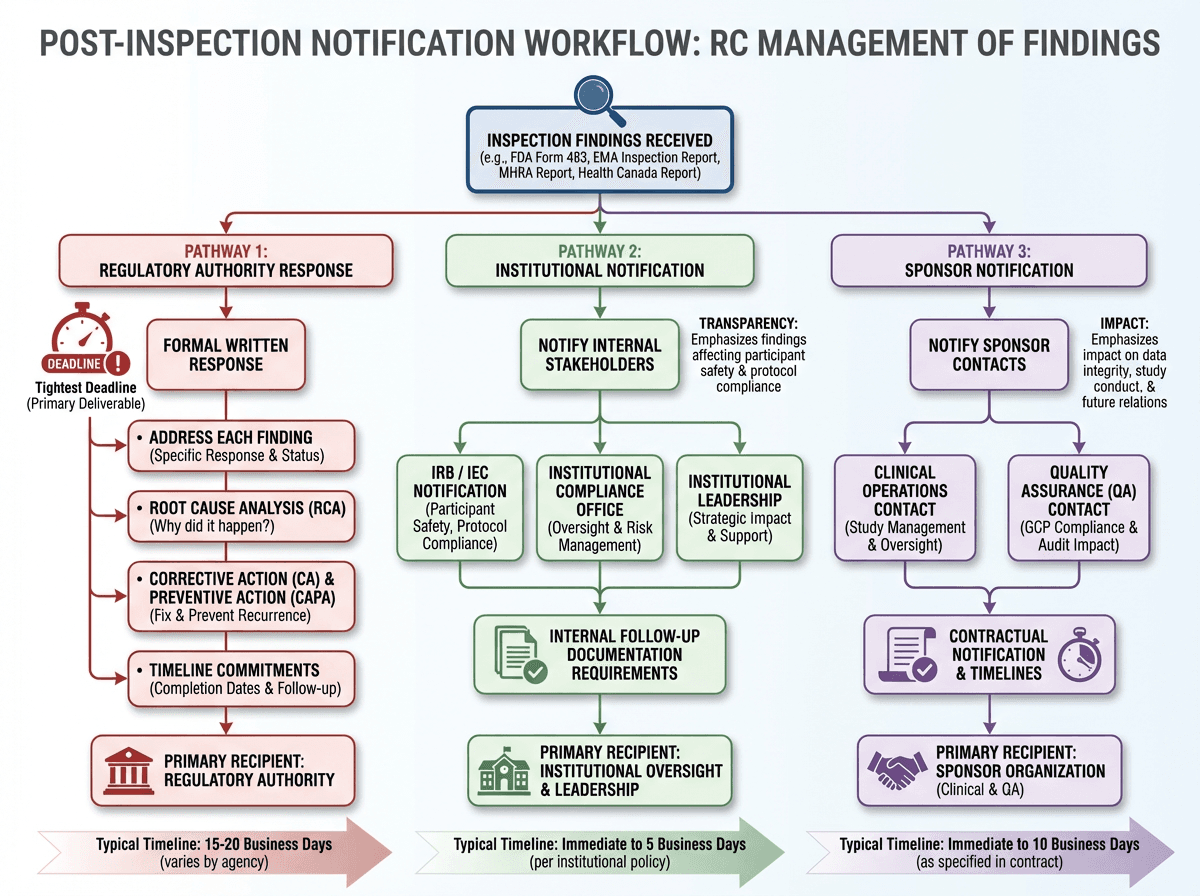
When inspection findings arrive -- whether as an FDA 483, an EMA-coordinated inspection report, an MHRA report, or a Health Canada report -- the RC must manage parallel notification obligations to three distinct audiences. Each audience needs different information, at different levels of detail, on different timelines. Failing to notify any one of them creates problems that compound the original finding.
The formal response to the regulatory authority is the primary deliverable, and its content requirements were addressed earlier in this lesson for each authority. But beyond the content, the RC should attend to three procedural details that affect how the response is received.
Format and delivery. The FDA accepts 483 responses by mail or through the FDA's electronic submissions gateway. The response should be on institutional letterhead, signed by the investigator (not the RC -- though the RC drafts it), and organized so that each 483 observation is addressed in the order it appears on the form. For EMA, MHRA, and Health Canada, the response format is specified in the inspection report or accompanying correspondence. The RC should follow the specified format exactly -- reformatting findings to match the site's preferred structure, rather than the authority's, signals that the site does not take the authority's process seriously.
The response should be factual, specific, and non-defensive. "We respectfully disagree with this characterization" is acceptable when supported by evidence. "We feel this observation does not reflect our usual standard of practice" is defensive and unpersuasive. The reviewing official reads dozens of 483 responses. The ones that stand out -- positively -- are the ones that demonstrate understanding without excuse-making.
The institution has its own oversight responsibilities, and most institutional policies require prompt notification of regulatory inspection findings. Institutional notification of inspection findings is typically governed by institutional policy and applicable regulatory requirements. While ICH E6(R3) Section 3.12.1 places the obligation on the sponsor to take action when noncompliance is discovered, the investigator's institutional responsibilities generally require prompt notification of regulatory findings to the compliance office and research administration. The RC operationalizes this requirement through a structured notification process.
IRB/IEC notification. Most IRBs require notification of FDA 483 observations and equivalent international inspection findings within a defined timeframe -- often 5 to 10 business days of receipt. The notification should include a copy of the 483 or inspection report, a summary of the findings in plain language, and the site's planned response. The IRB may require additional information or impose its own requirements, including increased monitoring, protocol modifications, or -- in serious cases -- suspension of enrollment pending resolution. The RC should know the institution's IRB reporting requirements before an inspection occurs, not after.
The sponsor has both a regulatory and a contractual interest in inspection findings at the investigator site. Per ICH E6(R3) Section 3.11.1, the sponsor's quality assurance program includes oversight of investigator sites, and inspection findings at a site are relevant to the sponsor's own quality management obligations. Additionally, most clinical trial agreements include provisions requiring prompt notification of regulatory inspection findings -- often within 24 to 72 hours of receipt.
The sponsor notification should include: the identity of the inspecting authority, the date(s) of the inspection, the studies affected, a summary of findings, and the site's planned response timeline. The RC should not wait until the formal response is complete to notify the sponsor -- early notification allows the sponsor to assess the findings' impact on data integrity and regulatory strategy and to offer support for the site's response development.
And there is a practical dimension worth noting. Sponsors -- particularly in global trials -- may have experience with the inspecting authority's expectations and can provide guidance on response content and format. An experienced sponsor's regulatory affairs team is a resource, not merely a notification recipient. The RC should approach the sponsor notification as an opportunity for collaboration, not simply a contractual obligation.
Designing the response: addressing three audiences from one set of findings
The regulatory authority wants to see that the site understands why each finding occurred, not just what occurred. Structure the response so that each finding receives its own section with four elements: acknowledgment of the observation in the site's own words, root cause analysis that identifies systemic causes, corrective action with specific completion dates, and preventive action that extends beyond the immediate finding to protect analogous processes. Include evidence of completed actions where available.
The institution's primary concern is whether findings implicate participant safety, whether the IRB needs to take action, and whether institutional policies were followed. The institutional notification should translate regulatory language into operational impact: which participants were affected (if any), what the safety implications are, what the IRB's reporting requirements mandate, and what the site's corrective action timeline looks like. Provide plain-language summaries alongside the formal inspection documents.
One of the most consequential differences between the FDA inspection model and the international models is the presence or absence of formal severity classification. The FDA 483 lists observations without grading them -- every observation receives the same formal treatment, and the reviewing official determines severity during the post-inspection review. The EMA, MHRA, and Health Canada all classify findings by severity at the time of the inspection report.
This difference has operational implications the RC must internalize. When responding to an FDA 483, every observation warrants a thorough response because the site does not know which observations the reviewing official will consider most significant. When responding to an EMA or MHRA report with classified findings, the site knows exactly which findings the inspectorate considers Critical, Major, or Minor -- and the response must allocate depth accordingly.
A Critical finding in the EMA or MHRA system demands the most comprehensive response: detailed root cause analysis, immediate corrective action (already underway, not merely planned), systemic preventive action, and evidence of implementation. A Minor finding warrants acknowledgment and a proportionate response but does not require the same depth of systemic analysis. Treating all classified findings identically -- giving a Minor finding the same extensive treatment as a Critical finding -- does not demonstrate thoroughness. It demonstrates that the site does not understand the classification system.
The post-inspection response is not a formality to be completed and filed. It is a demonstration of the site's quality management capacity -- and it is read by people whose subsequent decisions affect the site's regulatory standing, the sponsor's regulatory strategy, and ultimately the participants whose data was reviewed during the inspection.
For FDA 483 responses, the architecture is clear: address every observation individually, with acknowledgment, root cause analysis, corrective action, and preventive action, submitted within 15 business days. For international inspections -- EMA, MHRA, Health Canada -- the architecture is similar in substance but different in procedural detail: severity-classified findings require proportionate response depth, timelines vary by authority, and escalation pathways affect trial authorization rather than (or in addition to) site-level enforcement.
But beyond any single authority's process, the RC must manage the parallel notification framework: the regulatory authority, the institution, and the sponsor each need specific information, on specific timelines, at specific levels of detail. The RC who coordinates all three notification pathways from the day findings are received -- not sequentially, but simultaneously -- demonstrates the organizational capacity that every stakeholder wants to see.
Progress saves itself — finish reading and this lesson completes
ICH E6(R3) Section 3.12.2 requires that when significant noncompliance is identified, the sponsor should perform a root cause analysis and implement appropriate corrective and preventive actions. In practice, this means the sponsor will hold the site to these standards -- and the RC who proactively applies root cause analysis and CAPA methodology (as taught in Module 3) positions the site to meet these expectations.
Corrective action taken or planned. Describe specifically what the site has done or will do to correct the observed condition. Specificity matters. "We have retrained staff" is not a corrective action -- it is a gesture. "We have implemented a quarterly delegation log verification procedure, assigned to the regulatory coordinator, with documented review of every active study's delegation log against current staffing records" is a corrective action. Include completion dates for actions already taken and target dates for planned actions.
Preventive action to avoid recurrence. Describe what systemic changes the site will implement to prevent the same type of finding from recurring -- not just in the study where it was observed, but across the site's portfolio. This is the element that most clearly demonstrates quality management maturity, and it is the element most sites neglect.
The classification determines the urgency and depth of the required response. A Critical finding demands an immediate response -- typically within 30 calendar days -- with a detailed corrective action plan. The RC must understand that an EMA Critical finding carries more immediate consequences than an ungraded FDA 483 observation, because the classification itself communicates the inspectorate's severity assessment to the marketing authorization review process. EMA inspection findings can directly affect marketing authorization decisions, which gives sponsors an acute interest in the site's response quality.
Escalation. If critical findings are not adequately addressed, the consequences extend beyond the site. The EMA can recommend that the Committee for Medicinal Products for Human Use (CHMP) consider the inspection findings in its marketing authorization evaluation. Data from an inadequately addressed inspection may be excluded from the application. The sponsor's commercial interests -- not just the site's regulatory standing -- are at stake.
Response timeline. The MHRA typically expects a response within 25 working days of the inspection report, though the report itself specifies the deadline. The response must address each classified finding with root cause analysis, corrective action, and preventive measures -- substantively identical to the FDA 483 response content, but organized by the MHRA's classification framework.
Escalation. The MHRA can issue non-compliance notices, suspend or terminate a clinical trial authorization, or impose conditions on continued trial conduct under the UK Medicines for Human Use (Clinical Trials) Regulations. For the RC, the critical operational insight is that MHRA escalation can directly halt a trial's authorization in the UK -- a consequence that is swifter and more directly operational than the FDA's Warning Letter pathway.
Response timeline. The inspection report specifies the response deadline, which varies based on the severity of findings. Critical findings typically require a response within a shorter timeframe -- often stated in the report itself -- with subsequent follow-up to demonstrate implementation. The RC should treat the deadline stated in the report as absolute, not advisory.
Escalation. Health Canada can issue regulatory letters requiring corrective action, suspend a Clinical Trial Application (effectively halting enrollment and treatment under the affected protocol), or impose conditions on continued authorization. The integration of inspection findings into the CTA lifecycle means that the sponsor is notified of findings and their potential impact on authorization status, creating strong sponsor interest in the site's response.
Evidence of action. Where corrective actions have already been completed before the response is submitted, include documentation. A revised SOP, a completed training log, a screenshot of an implemented system change -- these transform the response from a collection of promises into a demonstration of action. For planned actions not yet complete, provide specific target dates and the name of the responsible individual.
Institutional compliance office. Many academic medical centers and hospital systems have compliance offices that track regulatory inspection outcomes across the institution. The compliance office may have its own reporting requirements, its own timelines, and its own expectations for corrective action documentation. The RC should include the compliance office in the notification chain within the first 48 hours of receiving findings.
Institutional leadership. Depending on the severity of the findings, the department chair, research dean, or institutional official may need to be notified. Critical findings -- those that implicate participant safety or data integrity -- warrant immediate escalation to institutional leadership. The RC should work with the investigator to determine the appropriate level of institutional notification for each finding's severity.
Per ICH E6(R3) Section 3.10.1.6, risk reporting requirements include communicating quality-relevant information to appropriate stakeholders. Inspection findings are, by definition, quality-relevant information. The sponsor is, by definition, an appropriate stakeholder.
The sponsor's primary concern is the inspection's impact on data integrity and regulatory strategy. The sponsor notification should clearly identify which studies were inspected, which findings affect data reliability, whether enrollment or treatment should be paused, and what support the site needs from the sponsor's regulatory affairs team. Many sponsors have standard templates for site inspection notification -- the RC should ask whether the sponsor has a preferred format.
The regulatory response has the most defined timeline (15 business days for FDA, 25-30 days for others). Institutional notification is typically fastest -- IRB notification within 5-10 business days of receipt. Sponsor notification is often contractually defined at 24-72 hours. The RC should map all three timelines on the day findings are received, working backward from the regulatory response deadline to allocate time for drafting, investigator review, institutional coordination, and sponsor consultation. These obligations run in parallel, not in sequence.
The next lesson addresses what comes after the response: implementing the corrective and preventive actions promised, tracking their completion, verifying their effectiveness, and preparing for the follow-up inspection that will evaluate whether the site delivered on its commitments. The promises made in the response are only as credible as the actions that follow.
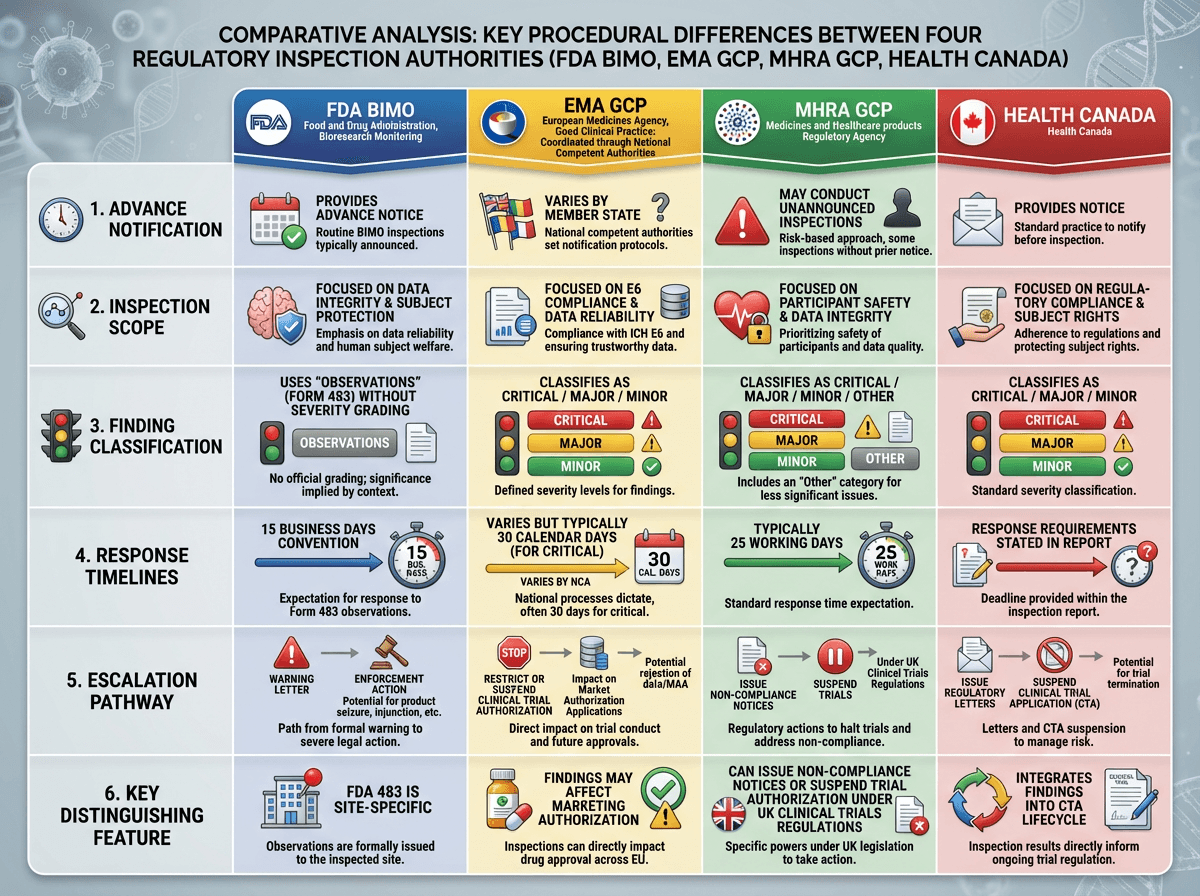
TableRegulatory inspection comparison: key procedural differences
| Advance notification | Yes, for routine BIMO inspections | Varies by member state NCA | May be unannounced | Yes, typically several weeks |
| Finding classification | Observations (ungraded) | Critical / Major / Minor | Critical / Major / Minor / Other | Critical / Major / Minor |
| Response timeline | 15 business days (convention) | ~30 calendar days for Critical | 25 working days (stated in report) | Stated in inspection report |
| Escalation pathway | Warning Letter, then enforcement | Affects marketing authorization decision | Non-compliance notice; trial suspension | CTA suspension; regulatory letter |
| Finding impact scope | Site-specific regulatory record | May affect product marketing authorization across EU | May affect UK trial authorization | Integrated into CTA lifecycle |
| Response addressed to | FDA district director | National competent authority that inspected | MHRA GCP inspectorate | Health Canada inspectorate directorate |
Question 1 of 3. Not yet answered.